🔄 Last verified: 26 September 2026 — This guide covers the established sports and NCC routine at Sainik Schools (evergreen content). Exact timings and facilities vary slightly from school to school.
The most common question we hear from parents isn’t about fees or cut-offs. It’s this: “Will my child do anything except study there?”
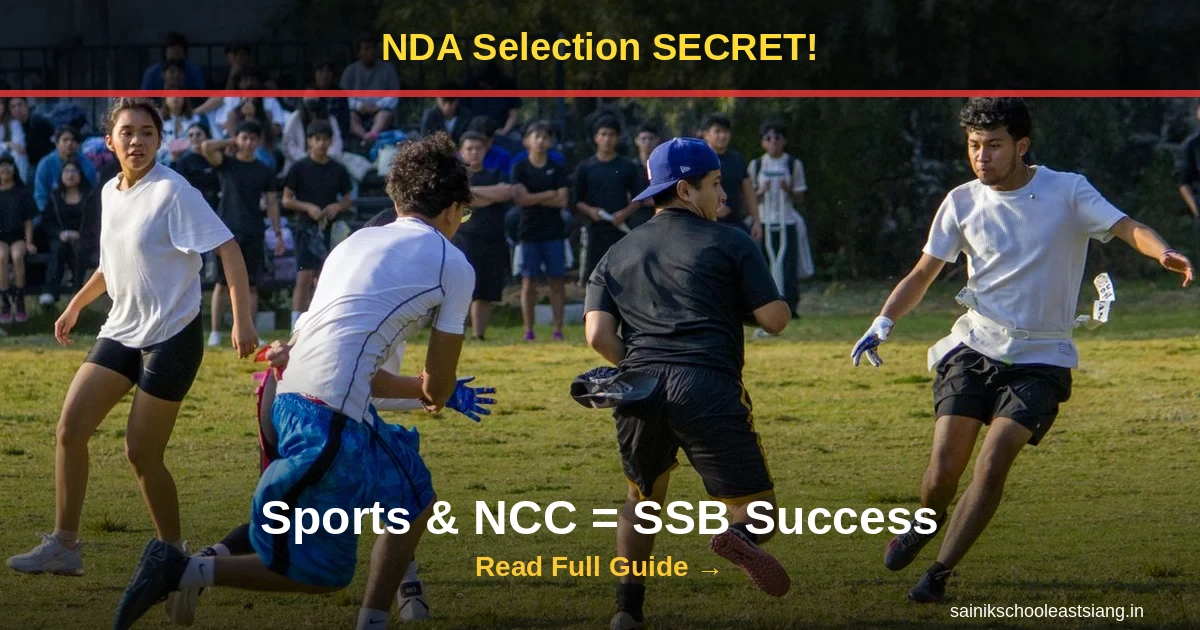
Short answer: yes — a lot. In fact, at a Sainik School, sports and NCC aren’t extras. They’re the point. These schools were built to produce officers, and nobody becomes an officer by sitting at a desk all day. Fitness, teamwork, discipline, leading a group when you’re tired and the score is against you — all of that is learned on the field, not in a classroom.
A parent once told us she was worried her son — a quiet boy who spent his evenings on the sofa — would be the odd one out on day one. Six months later, he was waking up before the alarm and playing football every evening. Nobody forced him. The routine just carried him along. That’s how it works there.
The day starts early. Every school sets its own exact timings, but the shape is the same everywhere:
| Time | What happens |
|---|---|
| ~5:30–6:00 AM | Wake up, then morning PT (physical training) |
| Morning | Academic periods |
| Midday | Lunch and rest |
| Evening | Games period — every single day |
| Night | Prep (self-study) time, then lights out |
Two things are non-negotiable across all 33 schools: PT in the morning and games in the evening. Miss a class and you’ll get notes to copy. Skip games and someone will come looking for you. That’s the culture.
For the full hour-by-hour picture, see our daily routine and timetable guide.
Facilities differ by campus — older, larger schools tend to have more — but here’s what you’ll typically find:
And it doesn’t stop at practice. Sainik Schools compete against each other — zonal and national-level inter-school competitions happen every year. For many boys and girls, their first real taste of performing under pressure comes in a Sainik School football final, not an exam hall. That’s deliberate.
Honestly, this is the part parents underestimate most. A child who has played team sports for six years walks into an SSB interview a different person — louder, calmer, used to being watched. You can’t coach that in a month.
Every Sainik School has NCC (National Cadet Corps) training, and it’s treated seriously — not as a weekly checkbox activity, but as part of the school’s identity.
What NCC training typically includes:
Now, the question parents actually want answered: does the NCC certificate help with NDA?
Here’s the honest version. For NDA itself, there is no shortcut — your child still has to clear the written exam and the SSB. But NCC ‘C’ certificate holders do get dedicated entries in some defence selections (the NCC Special Entry for the Army is the well-known one), and at the SSB, an NCC background is a genuine advantage. The assessors can tell within minutes which candidates have stood on a parade ground before and which haven’t. Drill teaches you to follow; camps teach you to lead small groups; both show up in group tasks.
Our advice: if your child dreams of NDA, treat NCC as seriously as mathematics. It pays off quietly, over years. Read the full Sainik School to NDA roadmap and career options after Sainik School for the bigger picture.
This worry comes up in almost every counselling call we get. Here’s the truth:
One sincere suggestion, though: don’t wait for admission to start. Get your child running 20–30 minutes a day now, while AISSEE preparation is going on. There’s no physical test in the entrance exam — but the fitter they arrive, the easier the first term feels.
Q1. Is there a physical test in the AISSEE entrance exam? No. AISSEE is a written, OMR-based exam only (✅ CONFIRMED — 2026 pattern, expected to repeat for 2027). Physical training starts after admission. That said, arriving fit makes the first term dramatically easier.
Q2. Is NCC compulsory for girls too? Yes — NCC training is part of the routine for everyone at the school, and it’s designed to be age-appropriate. Girls have a confirmed quota of 10% of vacancies (or 10 seats, whichever is more) in the 33 established schools (✅ CONFIRMED — Sainik Schools Society SOP).
Q3. What happens if my child falls ill? Every school has an MI Room (medical inspection room) with trained staff. Serious cases go to the nearest military or civil hospital. Read the medical test guide for what the admission medical covers.
Q4. Can a child be thrown out for being bad at sports? No. Nobody gets removed for poor sports performance alone. The whole point of the training is improvement, not elimination.
Q5. Does an NCC certificate give direct entry into NDA? No direct entry — the NDA written exam and SSB are mandatory for everyone. But NCC ‘C’ certificate holders have dedicated entries in some defence selections, and the training background is a real, visible advantage at SSB.
Q6. Is there ragging in Sainik School hostels? Sainik Schools enforce strict anti-ragging rules. The senior-junior relationship is structured as mentorship — seniors are expected to guide new students, and housemasters supervise closely.
Read next: Daily routine and timetable | Physical test guide | Sainik School to NDA roadmap | Hostel life
How helpful was this article?