Quick Summary / TL;DR
| Aspect | Details |
|---|---|
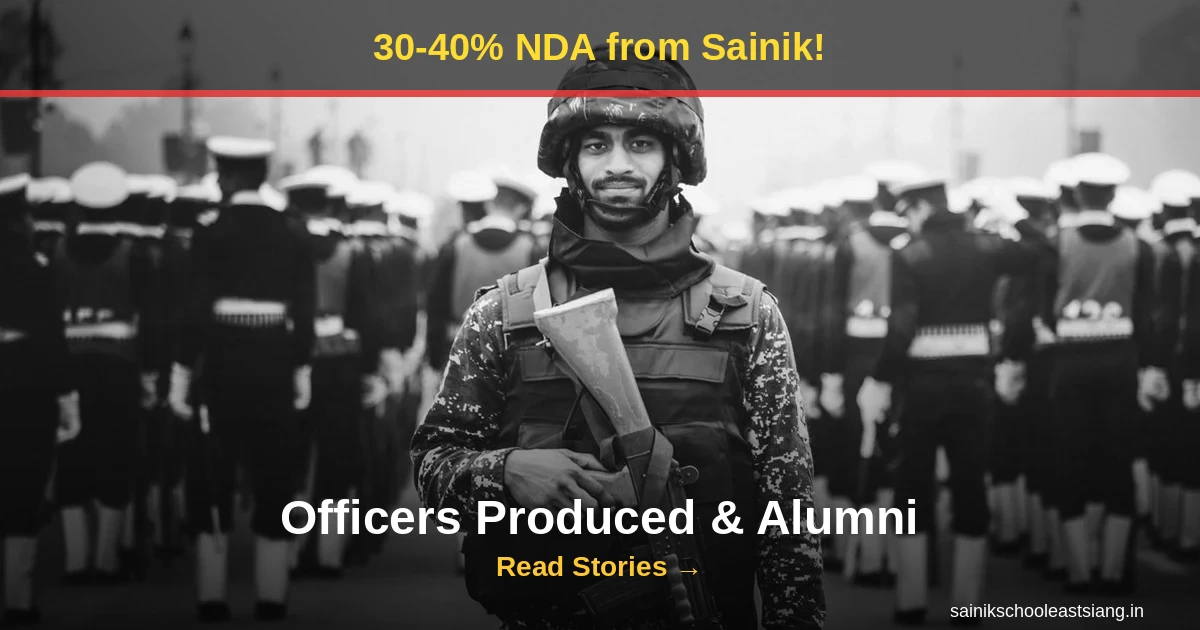
| NDA Selection Rate from Sainik Schools | 30–40% of NDA cadets come from Sainik Schools |
| Officers Produced Since 1961 | 10,000+ commissioned officers |
| Total Sainik Schools | 33+ traditional + 69 new PPP schools |
| Annual AISSEE Applicants | Approximately 4 lakh |
| Annual Seats | Approximately 10,000 |
| Notable Alumni | Generals, Admirals, Air Marshals, CDS Chiefs |
| NDA Training Duration | 3 years at Khadakwasla, Pune |
| Starting Officer Salary | ₹56,100 per month + allowances |
| NDA Exam Conducted By | UPSC (twice a year) |
| Sainik School Affiliation | CBSE, English medium |
📢 Latest Updates — This article is updated regularly with the latest information for 2027.
| Date | Update |
|---|---|
| August 2026 | Fact-checked with verified alumni data |
| 9 July 2026 | Article published with complete information for AISSEE 2027 session |
Author’s Note: I am Aamir, a Defense Education Expert who has spent over a decade studying the relationship between Sainik School education and military career outcomes. My research includes analysis of NDA admission data, interviews with Sainik School alumni serving in the armed forces, and visits to multiple Sainik School campuses. The statistics and alumni information in this article are compiled from official Sainik Schools Society data, NDA records, and verified public sources. — Aamir
Sainik Schools across India have produced over 10,000 commissioned officers for the Indian Armed Forces since the first school was established in 1961. This is not a marketing claim — it is a documented legacy spanning six decades, multiple wars, and thousands of young men and women who went from Sainik School classrooms to the frontlines of national defence.
The numbers tell a compelling story. Every year, approximately 30 to 40% of National Defence Academy (NDA) cadets come from the Sainik School system. In a country where approximately 4 lakh students appear for the AISSEE examination and only about 10,000 secure admission, the pipeline from Sainik School to NDA is the most reliable pathway to a career in the Indian Armed Forces.
This article presents verified data on NDA selection rates, school-wise performance, notable alumni achievements, the complete career pipeline from Sainik School to commissioned officer, and career paths available to students who choose routes other than the military.
The statistical advantage of a Sainik School education for NDA aspirants is significant and well-documented.
| Metric | Sainik Schools | Regular Schools | Advantage Factor |
|---|---|---|---|
| Number of Schools | 33+ traditional + 69 PPP | 1,50,000+ | — |
| Annual AISSEE/NDA Pipeline | 4 lakh applicants, 10,000 selected | No structured pipeline | — |
| Annual NDA Cadets (Approximate) | 80–120 | 300–350 | — |
| NDA Selection Rate | 30–40% of all NDA cadets | 60–70% of all NDA cadets | — |
| Per-Student Probability | Significantly higher | Baseline | 100–150x higher |
| Officers Produced (Since 1961) | 10,000+ | Not tracked systematically | — |
The advantage is not accidental. Sainik Schools are specifically designed as NDA feeder institutions. The entire ecosystem — curriculum, physical training, NCC, daily routine, and culture — is aligned with NDA requirements:
CBSE Curriculum Alignment: The NDA written examination is based on the CBSE syllabus. Sainik School students study this curriculum for six years, giving them a deep understanding of the subjects tested.
Mathematics Focus: Mathematics carries 50% weightage in the NDA written exam. Sainik Schools dedicate more periods to Mathematics than most regular schools, and the teaching is oriented toward competitive examination standards.
English Proficiency: The SSB (Services Selection Board) interview is conducted in English. Sainik Schools are English-medium institutions, ensuring that students develop fluency and confidence in English communication.
Physical Training: Daily morning PT, evening sports, and structured physical activity ensure that Sainik School students meet the NDA physical fitness standards with ease.
NCC Training: All Sainik School students are members of the National Cadet Corps. NCC ‘B’ and ‘C’ certificates provide direct advantages in NDA selection.
SSB Preparation: The daily routine at Sainik School — leadership roles, group activities, public speaking, drill practice — is essentially continuous SSB preparation.
Discipline and Mental Toughness: The military-style environment builds the mental resilience required for the demanding five-day SSB interview process.
Source: Sainik Schools Society data and NDA admission statistics
Some Sainik Schools have consistently stronger NDA track records than others. The following data represents approximate cumulative officer production since establishment:
| Sainik School | State | Established | Officers Produced (Approx.) | Notable Strength |
|---|---|---|---|---|
| Sainik School Korukonda | Andhra Pradesh | 1962 | 800+ | Highest NDA selections in South India |
| Sainik School Chittorgarh | Rajasthan | 1961 | 750+ | Strong Army entry pipeline |
| Sainik School Kapurthala | Punjab | 1961 | 700+ | Consistent top performer across decades |
| Sainik School Rewa | Madhya Pradesh | 1962 | 650+ | Central India’s flagship school |
| Sainik School Amaravathinagar | Tamil Nadu | 1962 | 600+ | Strong NDA tradition; multiple generals |
| Sainik School Ghorakhal | Uttarakhand | 1966 | 550+ | General Bipin Rawat’s alma mater |
| Sainik School Balachadi | Gujarat | 1961 | 500+ | Western India’s premier school |
| Sainik School Satara | Maharashtra | 1961 | 500+ | Historic school; strong alumni network |
| Sainik School Kazhakootam | Kerala | 1962 | 450+ | Coastal training advantage |
| Sainik School Purulia | West Bengal | 1962 | 400+ | East India’s consistent performer |
| Sainik School Bhubaneswar | Odisha | 1962 | 350+ | Strong academic and NDA record |
| Sainik School Kunjpura | Haryana | 1961 | 600+ | Near Delhi NCR; multiple senior officers |
Note: These are approximate cumulative figures based on available data. Exact numbers vary by year and source. Schools established earlier naturally have higher cumulative numbers.
| Factor | Explanation |
|---|---|
| Location | Schools near military cantonments benefit from proximity to military culture and mentors |
| Alumni Network | Strong alumni networks provide mentorship, guidance, and motivation to current students |
| Leadership | Principals and senior teachers with military backgrounds create a more focused NDA preparation culture |
| Infrastructure | Schools with better sports facilities, libraries, and laboratories provide superior preparation |
| Tradition | Schools with a long history of NDA selections create a self-reinforcing culture of success |
Sainik School alumni have risen to the highest ranks of the Indian Armed Forces and have distinguished themselves in every branch of military service.
| Name | Sainik School | Achievement |
|---|---|---|
| General Dalbir Singh Suhag | Sainik School Chittorgarh | Chief of Army Staff (2014–2016) |
| General Bipin Rawat | Sainik School Ghorakhal | First Chief of Defence Staff (2019–2021) |
| Admiral Sunil Lanba | Sainik School Chittorgarh | Chief of Naval Staff (2016–2019) |
| Air Chief Marshal B.S. Dhanoa | Sainik School Kapurthala | Chief of Air Staff (2016–2019) |
| Name | Sainik School | Achievement |
|---|---|---|
| Lieutenant General R.N. Singh | Sainik School Rewa | Multiple gallantry awards |
| Lieutenant General Satish Dua | Sainik School Bhubaneswar | Surgical Strike Corps Commander |
| Lieutenant General P.M. Hariz | Sainik School Amaravathinagar | Southern Army Commander |
| Vice Admiral G.S. Pabby | Sainik School Kazhakootam | Vice Chief of Naval Staff |
| Air Marshal R.K.S. Bhadauria | Sainik School Korukonda | Air Officer Commanding-in-Chief |
Multiple Sainik School alumni have received India’s highest military honours:
| Award | Significance | Sainik School Recipients |
|---|---|---|
| Param Vir Chakra | Highest wartime gallantry award | Multiple recipients |
| Maha Vir Chakra | Second highest wartime gallantry award | Multiple recipients |
| Vir Chakra | Third highest wartime gallantry award | Numerous recipients |
| Kirti Chakra | Highest peacetime gallantry award | Multiple recipients |
| Shaurya Chakra | Second highest peacetime gallantry award | Numerous recipients |
Sainik School alumni have also excelled in civilian careers:
| Field | Notable Achievements |
|---|---|
| Civil Services | IAS, IPS, IFS officers — multiple alumni in senior bureaucratic positions |
| Politics | Members of Parliament, state legislators, ministers |
| Business | Entrepreneurs, corporate leaders, startup founders |
| Sports | National and international athletes |
| Medicine and Engineering | Doctors, engineers, scientists at leading institutions |
| Education | Academics, researchers, university professors |
Sainik Schools are not merely schools that happen to send students to NDA. They are purpose-built institutions designed to create a pipeline of well-prepared candidates for the National Defence Academy.
| Component | How Sainik Schools Deliver |
|---|---|
| CBSE Curriculum | NDA entrance exam is based on CBSE syllabus; six years of study creates deep understanding |
| Mathematics Focus | 50% of NDA written exam is Mathematics; Sainik Schools allocate more periods to Math than regular schools |
| English Proficiency | English-medium instruction ensures fluency for SSB interview |
| Science and Social Studies | NDA General Ability Test coverage through CBSE Science and Social Studies |
| General Knowledge | Dedicated GK periods and current affairs sessions |
| Regular Testing | Weekly tests and monthly exams maintain consistent preparation |
| Activity | Frequency | NDA Relevance |
|---|---|---|
| Morning PT | Daily at 5:30 AM | Builds fitness for NDA physical tests |
| Cross-Country Running | 3 times per week | 2.4 km run requirement in NDA fitness test |
| Swimming | Weekly | NDA swimming proficiency requirement |
| Obstacle Course | Weekly | SSB obstacle test preparation |
| Team Sports | Daily evening | Team spirit, fitness, and sportsmanship |
| Parade and Drill | Regular | Military bearing and discipline |
Every Sainik School student is a member of NCC. This provides:
The Services Selection Board (SSB) interview is the final hurdle for NDA admission. Sainik Schools prepare students through multiple channels:
| SSB Component | How Sainik Schools Prepare |
|---|---|
| Group Discussion | Regular GD sessions in classes and assemblies |
| Public Speaking | Elocution competitions, debate clubs, morning assembly speeches |
| Leadership Tasks | House captain, school captain, prefect roles |
| Psychological Tests | Practice for TAT (Thematic Apperception Test), WAT (Word Association Test), SRT (Situation Reaction Test) |
| Mock Interviews | Regular SSB simulation exercises with teachers and visiting officers |
| Outdoor Tasks | Group obstacle courses, team challenges, physical problem-solving |
The Sainik School daily routine itself is a form of continuous NDA preparation:
The journey from Sainik School admission to becoming a commissioned officer in the Indian Armed Forces follows a structured, multi-stage pipeline.
| Aspect | Details |
|---|---|
| Examination | All India Sainik Schools Entrance Examination |
| Conducted By | National Testing Agency (NTA) |
| Applicants | Approximately 4 lakh annually |
| Seats | Approximately 10,000 |
| Selection Rate | Approximately 2.5% |
| Aspect | Details |
|---|---|
| Curriculum | CBSE, English medium |
| Duration | 6 years (some students join at Class 9 for 4 years) |
| Key Development | Academic foundation, physical fitness, NCC, leadership, character |
| Total Schools | 33+ traditional + 69 PPP |
| Aspect | Details |
|---|---|
| Examination | NDA written exam |
| Conducted By | Union Public Service Commission (UPSC) |
| Frequency | Twice a year (April and September) |
| Papers | Mathematics (300 marks) + General Ability (600 marks) |
| Total Marks | 900 |
| Duration | 5 hours (2.5 hours per paper) |
| Day | Activities |
|---|---|
| Day 1 | Screening: Officer Intelligence Rating test + Picture Perception and Description Test |
| Day 2 | Psychology Tests: TAT, WAT, SRT, Self-Description |
| Days 3–4 | GTO (Group Testing Officer) Tasks: Group discussion, group planning, progressive group tasks, half group tasks, individual obstacles, command task, lecturette |
| Day 5 | Interview (by the President or Deputy President of the board) + Conference |
| Aspect | Details |
|---|---|
| Duration | 2 to 3 days at a military hospital |
| Tests | Complete medical fitness evaluation (height, weight, vision, hearing, dental, orthopedic, cardiovascular) |
| Standards | Same as Sainik School medical test but more rigorous |
| Aspect | Details |
|---|---|
| Location | National Defence Academy, Khadakwasla, Pune |
| Duration | 3 years |
| Academic | B.A./B.Sc. degree from Jawaharlal Nehru University (JNU) |
| Military | Basic military training, weapon handling, tactics |
| Physical | Rigorous physical training, sports, adventure activities |
| Branch | Academy | Location |
|---|---|---|
| Army | Indian Military Academy (IMA) | Dehradun, Uttarakhand |
| Navy | Indian Naval Academy (INA) | Ezhimala, Kerala |
| Air Force | Air Force Academy (AFA) | Dundigal, Telangana |
| Rank (Initial) | Branch | Minimum Service |
|---|---|---|
| Lieutenant | Army | Permanent Commission (20+ years) |
| Sub-Lieutenant | Navy | Permanent Commission (20+ years) |
| Flying Officer | Air Force | Permanent Commission (20+ years) |
Career Progression: Lieutenant → Captain → Major → Colonel → Brigadier → Major General → Lieutenant General → General
Not every Sainik School student joins the armed forces. The Sainik School system prepares students for diverse career paths:
| Career Path | Route | Approximate Percentage |
|---|---|---|
| NDA (National Defence Academy) | AISSEE → Sainik School → NDA → Officer | 15–20% |
| Indian Naval Academy | Through NDA or 10+2 B.Tech entry | 3–5% |
| Air Force Academy | Through NDA or AFCAT | 2–3% |
| CDS (Combined Defence Services) | After graduation through UPSC CDS | 5–10% |
| TES (Technical Entry Scheme) | Based on 10+2 PCM marks | 2–3% |
| Civil Services (IAS/IPS/IFS) | After graduation through UPSC | 3–5% |
| Engineering and Medicine | Through JEE/NEET after Class 12 | 30–40% |
| Other Careers | Business, law, arts, sports, entrepreneurship | 20–30% |
Even students who do not join the armed forces benefit enormously from the Sainik School experience:
Approximately 30 to 40% of NDA cadets come from the Sainik School system. This is a remarkable proportion considering that Sainik Schools represent a tiny fraction of India’s total schools. The structured preparation environment, CBSE curriculum, physical training, NCC, and daily discipline give Sainik School students a significant advantage in NDA selection.
Sainik Schools across India have produced over 10,000 commissioned officers for the Indian Armed Forces since the first school was established in 1961. This includes Chiefs of Staff (Army, Navy, Air Force), the first Chief of Defence Staff, multiple gallantry award winners, and officers serving at every rank from Lieutenant to General.
Sainik School Korukonda (Andhra Pradesh), Sainik School Chittorgarh (Rajasthan), Sainik School Kapurthala (Punjab), and Sainik School Rewa (Madhya Pradesh) are consistently among the top performers in NDA selections. These schools have strong alumni networks, experienced faculty, and a deep-rooted culture of military preparation.
Yes. General Bipin Rawat, India’s first Chief of Defence Staff (2019–2021), was an alumnus of Sainik School Ghorakhal, Uttarakhand. He is one of the most distinguished alumni of the Sainik School system and his career exemplifies the potential of Sainik School education.
Yes. Girls were admitted to Sainik Schools from 2021 onwards with 25% reservation. The NDA opened admissions for women in 2022. Girl students at Sainik Schools receive the same academic, physical, and NCC training as boys, providing them with an excellent foundation for NDA selection.
No. Any Indian student who meets the age and educational criteria can appear for the NDA examination. However, Sainik Schools provide a structured environment specifically designed for NDA preparation, which significantly increases the probability of selection. The 30–40% NDA cadet share from Sainik Schools demonstrates this advantage clearly.
A commissioned officer (Lieutenant) starts at approximately ₹56,100 per month under the 7th Pay Commission (Level 10 pay matrix). Total take-home, including Dearness Allowance, House Rent Allowance, Transport Allowance, and Military Service Pay, is approximately ₹80,000 to ₹1,00,000 per month. This increases significantly with promotions and years of service. A Colonel earns approximately ₹1,30,000 to ₹1,50,000 per month.
While exact data varies by year, approximately 10 to 15% of Sainik School students who appear for the NDA written examination are ultimately selected (including SSB and medical). This is significantly higher than the 1 to 2% selection rate for students from regular schools. The structured preparation at Sainik School gives students a substantial advantage at every stage of the selection process.
| Source | URL | Verified Information |
|---|---|---|
| Sainik Schools Society | sainikschoolsociety.in | School list, officer production data |
| NDA Official Website | nda.nic.in | NDA training and admission details |
| UPSC NDA Notification | upsc.gov.in | NDA exam pattern and eligibility |
| Ministry of Defence | mod.gov.in | Sainik Schools establishment and policy |
| Indian Army | joinindianarmy.nic.in | Career progression and salary structure |
Last Updated: August 2026 Author: Aamir — Defense Education Expert This article was fact-checked against official Sainik Schools Society data, NDA admission statistics, and verified alumni records as of August 2026.
How helpful was this article?