Last verified: 16 November 2026. The exam date, timings, question counts, marks and qualifying rules in this article are ✅ CONFIRMED from the NTA AISSEE-2027 Information Bulletin (3 November 2026), as reported by The Telegraph (4 November 2026) and the Education Times (5 November 2026). The minute budgets, the three-pass method and the practice plan are our editorial guidance — they are how to use the pattern, not part of the pattern itself.
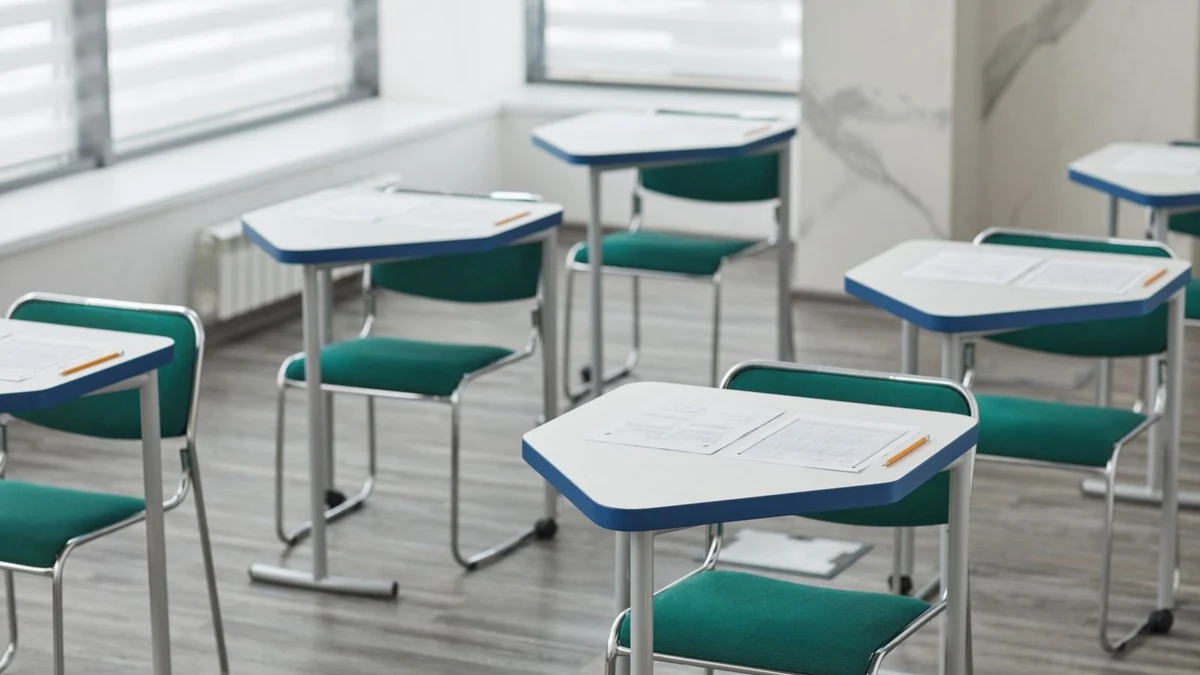
 Photo: Pexels
Here is a truth most preparation ignores: the AISSEE paper is not only a test of what your child knows. It is a test of what your child can show in 150 or 180 minutes, on an OMR sheet, at 2 in the afternoon, with a clock that does not pause. Two children with the same knowledge can finish 30 marks apart — and the difference is almost always the plan they walked in with.
With 76 days left to 31 January 2027, this is the right week to stop treating the paper as one big blur and start treating it as four timed blocks with a job each.
Class 6 — 150 minutes, 125 questions, 300 marks:
| Section | Questions | Marks | Minutes to budget |
|---|---|---|---|
| Mathematics | 50 | 150 | 60 |
| Language | 25 | 50 | 25 |
| Intelligence | 25 | 50 | 25 |
| General Knowledge | 25 | 50 | 20 |
| Buffer + OMR check | — | — | 20 |
| Total | 125 | 300 | 150 |
Class 9 — 180 minutes, 150 questions, 400 marks:
| Section | Questions | Marks | Minutes to budget |
|---|---|---|---|
| Mathematics | 50 | 200 | 75 |
| English | 25 | 50 | 25 |
| Intelligence | 25 | 50 | 25 |
| General Science | 25 | 50 | 25 |
| Social Science | 25 | 50 | 20 |
| Buffer + OMR check | — | — | 10 |
| Total | 150 | 400 | 180 |
Two things jump out. First, Mathematics is half the paper in both classes — 150 of 300 marks in Class 6, 200 of 400 in Class 9 — so it gets the biggest block, but not the whole paper. Second, the buffer is not spare time. It is the time your child uses to attempt the questions skipped in the first two passes and to check the OMR sheet. A plan without a buffer is a plan that breaks at the first hard question.
This is the core of the strategy. Teach it at home, then practise it in every mock until it is automatic.
Pass 1 — the confident pass (about 55–60% of the time). Go through the paper in order and answer only the questions your child can solve quickly and confidently. Skip anything that needs more than a minute of thought — mark it with a small circle in the question paper, not on the OMR sheet. This pass banks roughly 55–65% of the paper’s marks and, just as importantly, it tells your child the paper is beatable. Confidence is a resource; spend the first hour building it.
Pass 2 — the thinking pass (about 25% of the time). Return to the circled questions. Now the clock is familiar, the easy marks are safe, and the brain has had time to work on the hard ones in the background — that really happens. Solve what can be solved with a second look. Skip again anything that still resists.
Pass 3 — the attempt-everything pass (the buffer). There is no negative marking in AISSEE 2027: a wrong answer scores zero, exactly like a blank. So in the last 15–20 minutes, your child should attempt every remaining question with their best guess and bubble it. A guessed answer has a chance; a blank has none. This is the single easiest gain in the whole paper, and children who leave blanks throw it away.
One rule covers all three passes: bubble as you go. Fill the OMR circle right after answering each question, or at most after each small block of five. Never solve the whole paper and bubble at the end. A child who has solved everything and is bubbling in the last ten minutes is one announcement, one dropped pencil, one moment of panic away from losing the paper. Check the question number against the OMR row every single time — a shifted row is the cruellest way to lose a seat.
The bulletin is blunt, and parents keep missing it. A candidate needs 25% in each section and 40% in aggregate to qualify (the per-section rule does not apply to SC/ST candidates). For Class 6 that means at least 12.5 marks in each 50-mark section; for Class 9 the same in English, Intelligence, Science and Social Science, and 50 of the 200 in Maths.
Read that again. A child who scores 140 of 150 in Maths and 10 of 50 in GK does not qualify. The attempt strategy has to respect that: no section gets abandoned, and no section gets zero minutes. If GK is your child’s weakest section, it still gets its 20 minutes and its full attempt — and in the third pass, every GK question gets a guess. The section your child fears most is the section that decides whether the rest of the paper counts.
Getting stuck on one Maths question. Maths carries half the marks, so a hard Maths question feels worth fighting for. It is not. One question is 3 marks in Class 6 and 4 in Class 9. Ten minutes spent on it is ten minutes stolen from five easier questions elsewhere. Circle it, move on, come back in pass 2.
Reading the comprehension passage last. In Class 9 English, the passage questions are usually the easiest 8–10 marks in the section — if your child actually reads the passage. Children who leave English to the end read it in a rush and guess. Our Class 9 English section strategy gives the passage its own timed slot; use it.
Leaving blanks. Covered above, but worth repeating because it is so common: with no negative marking, a blank is the only answer that is guaranteed to score zero.
No clock discipline in practice. A child who has never attempted a full paper against a timer will discover the time pressure for the first time in the real hall. That is the wrong place to learn it. Every mock from now on should use the exact minute budgets in the tables above — same start time if possible, since the real exam begins at 2 PM, when most children are at their sleepiest.
| Week | Focus | Mock |
|---|---|---|
| 17–23 Nov | Learn the three-pass method on section-wise tests | 1 timed section test per section |
| 24–30 Nov | First full paper with the minute budget | 1 full paper, Sunday, 2 PM |
| 1–7 Dec | Fix the weakest section (it must cross 25%) | 1 full paper + weak-section drills |
| 8–14 Dec | Speed: shave 10 minutes off pass 1 | 1 full paper, timed strictly |
After the form closes on 2 December and the correction window (7–9 December) passes, the preparation changes character: fewer new topics, more timed papers. In January, move to two full papers a week. And keep the OMR mistakes checklist next to the study table — most of the marks lost in AISSEE are lost to the sheet, not the syllabus.
A parent told us last year that her son finished his paper with twenty minutes to spare and spent them re-checking the OMR rows, one by one. He found three bubbles in the wrong row. Three questions, nine marks in Class 6 — and his name was on the list. That is what a plan is for. Not brilliance. Just twenty calm minutes at the end.
How much time does AISSEE 2027 give Class 6 and Class 9?
Class 6 gets 150 minutes (2:00 to 4:30 PM) for 125 questions worth 300 marks. Class 9 gets 180 minutes (2:00 to 5:00 PM) for 150 questions worth 400 marks. Both papers are on Sunday, 31 January 2027, in pen-and-paper OMR mode.
Is there negative marking in AISSEE 2027?
No. Wrong answers and blank answers both score zero, so there is no penalty for attempting a question. That is why the third pass of this strategy says to attempt everything rather than leave blanks.
What is the 25% qualifying rule in AISSEE 2027?
A candidate needs at least 25% in each section and 40% in aggregate to qualify for a Sainik School seat. The per-section rule does not apply to SC and ST candidates. It means you cannot abandon your weakest section, however strong your best one is.
Should my child attempt the easy questions first in AISSEE?
Yes. The first pass should cover every question your child can answer confidently, which is usually 55 to 65% of the paper. That banks marks early, builds confidence, and leaves the hard questions for the second pass when the clock is no longer a stranger.
How should OMR bubbling be done in AISSEE?
Bubble after each question or each small block of questions, never save all bubbling for the end. A child who solves everything and bubbles in the last ten minutes is one distraction away from losing the whole paper. Check the question number against the OMR row every time.
How many mock tests should my child do before AISSEE 2027?
One full timed paper every week from now, rising to two a week in January, each attempted with this exact minute budget and OMR discipline. A mock done without the clock teaches the syllabus; a mock done with the clock teaches the exam.
How helpful was this article?