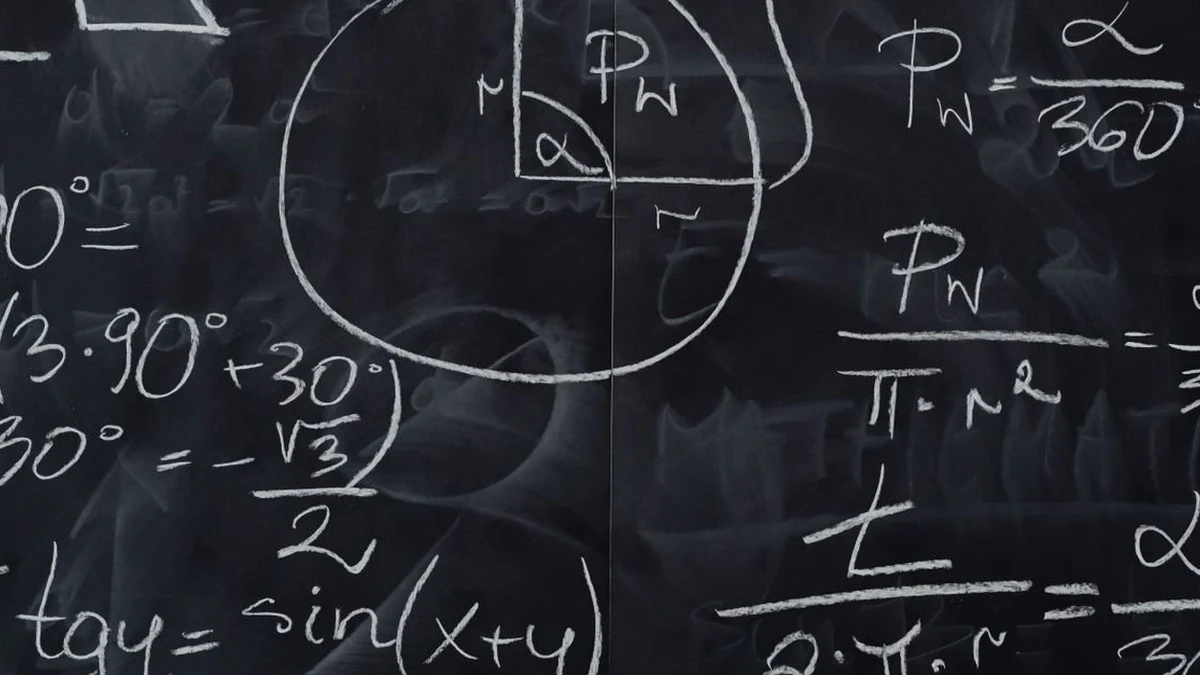
Last verified: 12 November 2026. The exam pattern and marks below are ✅ CONFIRMED from the NTA AISSEE 2027 Information Bulletin: Class 6, 150 minutes, 125 questions, 300 marks, no negative marking. The formulas are standard Class 6 mathematics as per NCERT — the exam is on 31 January 2027.
 Photo: Pexels
Maths is half the AISSEE Class 6 paper. Fifty questions, 150 marks out of 300. Language, Intelligence and GK share the other half between them. So when a parent asks me where the marks are, the honest answer is always the same: maths.
Here’s the thing, though — most children losing maths marks are not weak at maths. They are slow at it. They know how to find the area of a rectangle, but they spend a minute remembering the formula, another minute checking it, and then they run out of time on the last ten questions. The paper is 150 minutes for 125 questions. That is barely over a minute per question, and maths questions are the ones that eat time.
That is what this sheet is for. Thirty formulas, nothing more. Not a textbook, not a chapter — one page your child can revise in twenty minutes, once a week, until the formulas come without thinking. Print it, stick it on the wall next to the study table, and use it the way the plan below says.
One small scene first, because it is the reason this article exists. Last year, a parent called us in a panic because her son kept scoring 90 out of 150 in maths mocks while his friends scored 120. Same school, same coaching, same books. The difference, when we looked at his papers, was not knowledge — it was that he was re-deriving every formula from scratch during the exam. He knew the maths. He just had not practised recalling it fast. A formula sheet, revised weekly, fixed most of it in a month.
| What | Formula / rule |
|---|---|
| Divisibility by 2 | Last digit is even (0, 2, 4, 6, 8) |
| Divisibility by 3 | Sum of digits is divisible by 3 |
| Divisibility by 5 | Last digit is 0 or 5 |
| Divisibility by 9 | Sum of digits is divisible by 9 |
| Divisibility by 10 | Last digit is 0 |
| HCF of two numbers | Product of their common prime factors (lowest powers) |
| LCM of two numbers | Product of all prime factors (highest powers) |
| HCF × LCM | Equals the product of the two numbers |
| Average | Sum of all numbers ÷ count of numbers |
| Sum of first n natural numbers | n(n + 1) ÷ 2 |
| What | Formula / rule |
|---|---|
| Percentage | (Part ÷ Whole) × 100 |
| Finding the part | Whole × Percentage ÷ 100 |
| Profit | Selling Price − Cost Price |
| Loss | Cost Price − Selling Price |
| Profit % | (Profit ÷ Cost Price) × 100 |
| Simple Interest | (Principal × Rate × Time) ÷ 100 |
| Decimal to fraction | Write the decimal over 10, 100 or 1000 as per decimal places, then simplify |
| What | Formula / rule |
|---|---|
| Ratio | a : b = a ÷ b; simplify both sides by their HCF |
| Unitary method | Find the value of one unit first, then multiply |
| Speed | Distance ÷ Time |
| Distance | Speed × Time |
| Time | Distance ÷ Speed |
| What | Formula / rule |
|---|---|
| Perimeter of a rectangle | 2 × (Length + Breadth) |
| Area of a rectangle | Length × Breadth |
| Perimeter of a square | 4 × Side |
| Area of a square | Side × Side |
| Area of a triangle | ½ × Base × Height |
| Area of a parallelogram | Base × Height |
| Circumference of a circle | 2 × π × Radius (π = 22/7) |
| Area of a circle | π × Radius × Radius |
| Volume of a cuboid | Length × Breadth × Height |
| Volume of a cube | Side × Side × Side |
| Angles in a triangle | Add up to 180° |
| Right angle / straight angle | 90° / 180° |
Count them: 10 + 7 + 5 + 12 is more than 30, so here is the honest count — the sheet holds 34 entries, because the divisibility rules and angle facts are too useful to cut. Call it the 30-formula sheet anyway; nobody ever lost marks for knowing four extra rules.
Eighty days is roughly eleven weeks. Do not revise all 34 formulas every day — that is how a child stops revising at all. Instead, rotate:
| Week | Focus | How |
|---|---|---|
| Weeks 1–2 (now) | Numbers, factors, HCF/LCM, averages | 20 minutes, twice a week, with 10 practice questions per sitting |
| Weeks 3–4 | Fractions, decimals, percentages, profit/loss, simple interest | Same rhythm; add 5 questions from the previous block so it does not fade |
| Weeks 5–6 | Ratio, speed-distance-time, unitary method | These are the most repeated question types — do them inside timed sets |
| Weeks 7–8 | Geometry and mensuration | Draw every shape while revising its formula; a drawn rectangle is remembered better than a read one |
| Weeks 9–10 | Full-sheet revision, twice a week | One 20-minute sitting covering all 34; note the 5 weakest and drill only those daily |
| Week 11 (last week) | The weakest 5 only | No new formulas. Confidence, not coverage |
That last week matters most. Children who try to learn new things in the final week walk into the hall tired. Your child should walk in knowing the formulas cold and trusting that.
A formula sheet only works if it is used actively. Reading it is not revision. Here is the method that actually builds recall:
And pair this sheet with the question types that repeat every year. Our list of the 20 most repeated AISSEE maths question types shows where these formulas actually get used — most of them appear in the same five or six question shapes, year after year.
Units. The paper loves mixing them: a rectangle 2 metres long and 50 centimetres wide, a train travelling for 2 hours 30 minutes. The fix is boring and it works: convert everything to one unit before calculating, and write the unit next to every number. Make it a rule in practice, not a hope in the exam.
The last step. A child works out the area correctly, then forgets the question asked for the perimeter. Or finds the cost price when the question asked for the selling price. The fix: after solving, read the question once more before marking the answer. Ten seconds. It saves more marks than any formula on this sheet.
One more thing, because parents ask it every year: there is no negative marking in AISSEE 2027. A wrong answer scores the same as a blank — zero. So your child should attempt every maths question, even the ones they are unsure about. Our guide on attempting every question without negative marking explains how to guess smartly instead of randomly. And when mock scores stall, the final-80-days mock calendar shows how many mocks to take and how to use each one.
Eighty days is a long time in a child’s life and a short time in exam preparation. The formulas on this sheet are not the hard part — remembering them under pressure is. Start the rotation this week, and by January your child will not be remembering formulas in the exam hall. They will just be using them.
How many marks is Maths worth in the AISSEE Class 6 paper?
Maths is 50 questions for 150 marks out of the 300-mark paper — exactly half. It is the single biggest section, which is why formula fluency matters more here than anywhere else.
Does my child need to memorise all 30 formulas on this sheet?
Not by rote. The goal is recognition: see a question, know which formula it needs, and apply it without pausing. That comes from using each formula on 5 to 10 questions, not from reading the list.
Are these formulas enough for the AISSEE 2027 Class 6 maths section?
They cover the standard Class 6 syllabus — arithmetic, fractions, percentages, ratio, geometry and mensuration — as per NCERT Class 6 mathematics. The paper also tests reasoning inside maths questions, so pair this sheet with timed practice.
How often should my child revise this formula sheet in the final 80 days?
Once a week, in a single 20-minute sitting, plus 5 minutes of the weakest five formulas every day. The weekly plan in this article spreads the 30 formulas across four weeks so nothing is left to the last fortnight.
What is the most common maths mistake in AISSEE?
Unit mistakes — mixing metres and centimetres, or hours and minutes — and rushing the last step after doing the hard part right. The checklist at the end of this article targets exactly those two errors.
How helpful was this article?