🟢 Last verified: 26 September 2026 — ✅ CONFIRMED = from official source. 🔶 EXPECTED = pattern-based projection.
Let me say something that might sound odd from a study website: mock tests don’t teach your child anything new. Their real job is different — they convert knowledge into marks under pressure. A child who “knows” fractions but has never solved them against a ticking clock will lose 10–15 marks on exam day to nothing but panic and poor pacing. That’s the gap mock tests close. With the AISSEE 2027 exam on 31 January 2027 (✅ confirmed tentative, NTA calendar), here’s how to use the next four months of practice properly — whether you’re buying test series or using free papers.
You can’t practise effectively without knowing the paper’s shape:
| Class 6 | Class 9 | |
|---|---|---|
| Duration | 150 minutes | 180 minutes |
| Questions | 125 | 150 |
| Total marks | 300 | 400 |
| Maths | 50 Q / 150 marks | 50 Q / 200 marks |
| Other sections | Language, Intelligence, GK — 25 Q / 50 marks each | English, Intelligence, Gen Science, Social Science — 25 Q / 50 marks each |
| Medium | 13 languages | English only |
| Negative marking | None ✅ | None ✅ |
(Pattern per the 2026 bulletin, ✅ expected to repeat for 2027.) Two things jump out: Maths is half the paper in both classes, and with no negative marking, every question deserves an attempt. Your mock strategy should be built around those two facts.
| Period | Frequency | Purpose |
|---|---|---|
| October | 1 mock every 2 weeks | Get used to the format |
| November | 1 mock per week (Sunday) | Build stamina + timing |
| December | 2 mocks per week | Speed, accuracy, OMR rhythm |
| Early January | 1 mock per week | Maintain rhythm, light analysis |
| Last 10 days | None | Revision only — mocks now create anxiety |
That’s roughly 15–20 full papers before exam day. Honestly, that’s the sweet spot. Fewer and your child never builds exam temperament; more and you’re just grinding without learning. One full paper every Sunday morning, phone in another room, timed strictly — then Monday for analysis. That Monday analysis session is where 80% of the improvement happens, and it’s the part most families skip.
Here’s the routine after every mock:
A parent once told us her daughter kept getting the same type of percentage question wrong across five mocks — not because she didn’t understand percentages, but because she misread “of” as “off” in word problems. One line in the error notebook (“READ the question twice for percentage word problems”) fixed what three guidebooks hadn’t. That’s the power of analysis over volume.
For Class 6 (150 min, 125 Q — roughly 1 minute per question, keep 20–25 min for review):
For Class 9 (180 min, 150 Q): same logic — Intelligence and English first, Science and SST next, Maths last, ~30 minutes kept for review. And the 2-minute rule for everyone: if a question eats more than 2 minutes, mark it and move on. A stuck question is a thief — it steals time from three easy ones.
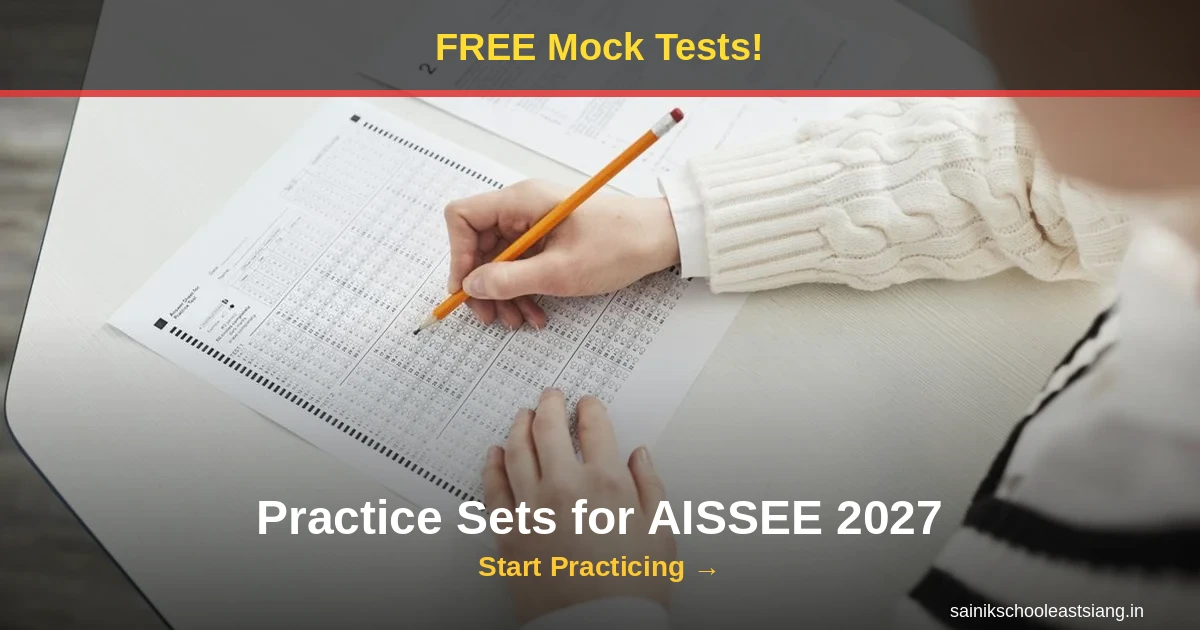
The exam is offline OMR (✅ 2026 pattern, expected repeat), and bubbling answers is a genuine skill. Common disasters: bubbling in the wrong row after skipping a question, incomplete circles the scanner rejects, running out of time with answers marked on the question paper but not transferred. The fix is boring and effective — practise on printed OMR sheets (easy to find online, or draw a grid). Two habits: bubble in batches (every 10 questions, transfer answers) and always double-check the question number matches the row. One misaligned row can cascade into five wrong answers.
Original practice questions in the AISSEE style, with answers. Use them to test your child’s current level.
Class 6 — Maths:
Class 6 — Intelligence: 4. Find the odd one out: Apple, Mango, Banana, Potato. (Answer: Potato — it’s a vegetable) 5. If CAT = 3120, what is DOG? (Answer: 4157 — position of each letter in the alphabet) 6. 2, 6, 12, 20, 30, ? (Answer: 42 — add 4, 6, 8, 10, 12)
Class 9 — Maths: 7. If x + 1/x = 4, find x² + 1/x². (Answer: 14) 8. The area of a circle is 154 cm². Find its radius. (π = 22/7) (Answer: 7 cm)
Class 9 — Science: 9. Which gas is released during photosynthesis? (Answer: Oxygen) 10. The SI unit of force is: (a) Joule (b) Newton (c) Watt (d) Pascal. (Answer: Newton)
If your child struggled with more than 3 of these, Phase 1 of preparation (concept-building) needs more time before heavy mock testing. That’s useful information, not bad news.
Don’t collect 50 PDFs you’ll never open. Pick 20 good papers and solve them twice — once timed, once for analysis.
When should my child start taking full mock tests? October for familiarisation, seriously from November. Starting full mocks too early (before the syllabus is covered) just produces demoralising scores. Topic-wise tests first, full papers later.
How many mock tests are enough? 15–20 full-length papers between November and mid-January, each followed by proper analysis. More than 25 is usually counterproductive.
My child’s mock scores aren’t improving. What now? Look at the error classification. If most errors are “silly mistakes,” it’s a focus/reading issue — slow down slightly and add a 5-minute re-check. If they’re “concept gaps,” stop mocking for a week and rebuild those topics. If it’s “time pressure,” the attempt order needs fixing, not more studying.
Should mocks be online or on paper? On paper, with an OMR-style answer sheet. The real exam is offline pen-and-paper, and screen practice doesn’t build bubbling skills or the same reading stamina.
Are free mock tests reliable? Some are, some aren’t. Verify the paper matches the official pattern — 125 questions/300 marks for Class 6, 150/400 for Class 9, no negative marking. A mock with the wrong pattern teaches the wrong instincts.
What should we do in the last 10 days? No full mocks. Light revision, the error notebook, and rest. A mock gone badly 5 days before the exam can do real damage to confidence — and confidence is part of the score.
Related guides: Previous year papers PDF · Final months strategy · Syllabus Class 6 & 9 · Exam-day tips · Topper tips
How helpful was this article?